


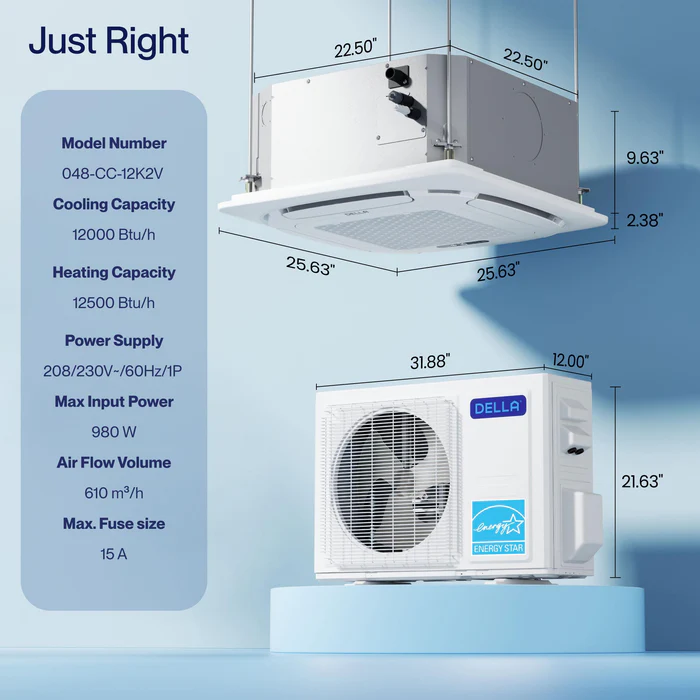

Ceiling cassette mini split systems are often selected for their ability to provide efficient cooling while maintaining a clean and unobtrusive appearance. Because the unit is installed within the ceiling, it avoids the visual impact of wall-mounted systems and distributes air more evenly across the space.
At the same time, installation requirements for a mini split AC can raise questions, especially regarding ceiling structure. Many people assume that a drop ceiling is necessary, but the reality is more nuanced. The feasibility of installation depends on several structural and spatial factors that go beyond ceiling type alone.
How Ceiling Structure Affects Cassette Mini Split Installation
Ceiling structure plays a central role in determining whether a cassette system can be installed without complications. Unlike surface-mounted units, a ceiling cassette mini split must fit within the ceiling cavity, which requires sufficient vertical clearance. This space is needed not only for the unit itself but also for refrigerant lines and drainage components.
In addition to space, the structural integrity of the ceiling is important. The unit is typically supported by brackets or suspension rods anchored to the building structure above. This ensures stability during operation and prevents vibration or long-term structural stress. Without proper support, installation may not meet safety or performance standards.
Do You Actually Need a Drop Ceiling for Installation
A drop ceiling is often associated with cassette systems because it naturally creates the space required for installation. However, it is not a strict requirement. What matters more is whether there is enough clearance between the finished ceiling and the structural surface above it.
In many residential settings, installation is still possible without a drop ceiling. If the ceiling cavity provides adequate depth and access, a ceiling cassette mini split can be integrated effectively. The presence of a drop ceiling simply makes the process more straightforward, but it is not the deciding factor.
Minimum Space and Structural Requirements for Proper Installation
Most ceiling cassette units require a certain amount of vertical clearance, typically in the range of 8 to 12 inches depending on the model. This space allows for proper airflow, drainage, and access to internal components. If the available space is too limited, installation may require modifications or may not be practical at all.
Other requirements include proper routing for electrical wiring and refrigerant piping, as well as a suitable location for condensate drainage. These elements must be planned carefully to ensure efficient operation. A professional assessment is often necessary to confirm that all technical conditions are met before installation begins.
Installation Options Without a Drop Ceiling
When a drop ceiling is not available, there are still workable solutions. One approach is to create a recessed section within the ceiling, allowing the unit to be installed without altering the entire ceiling structure. This method is commonly used in renovation projects where maintaining the overall design is important.
Another option is to take advantage of existing structural space, such as areas between beams or joists. While these alternatives can make installation possible, they often increase complexity and labor costs. Proper planning is essential to balance practicality, aesthetics, and long-term performance.
Key Factors to Consider Before Choosing a Ceiling Cassette System
Before selecting a ceiling cassette mini split, it is important to evaluate whether the space can support the installation requirements. Ceiling height, available clearance, and structural conditions should all be carefully considered to avoid complications during installation.
Maintenance access is another factor that should not be overlooked. Even though the system is concealed, it still requires periodic servicing. Ensuring that key components can be accessed without major disruption will help maintain efficiency and reduce future maintenance challenges.


