


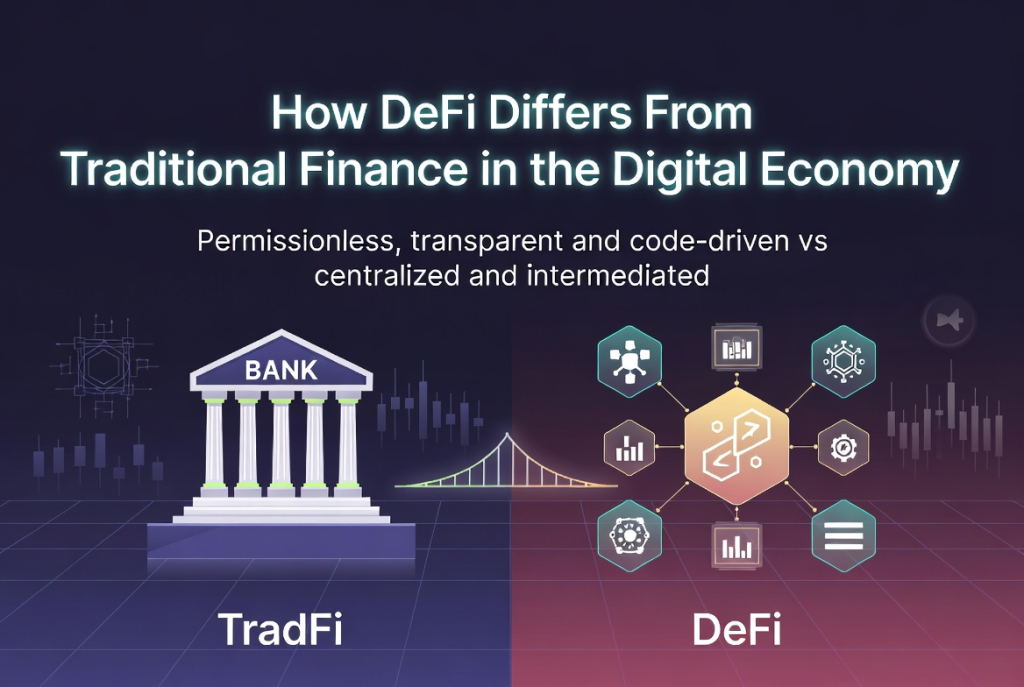

DeFi, or Decentralized Finance, has emerged as one of the most significant innovations in the financial world. It aims to recreate and improve upon traditional financial services using blockchain technology, smart contracts, and decentralized protocols, without relying on central intermediaries such as banks or brokers.
In current market conditions, the contrast between DeFi and traditional finance (TradFi) has become a central topic of discussion. While TradFi remains the foundation of global capital markets, DeFi offers an alternative model based on transparency, accessibility, and programmability. Understanding these differences helps traders and investors navigate both systems more effectively.
I have spent years working with both traditional financial instruments and decentralized protocols. The contrast is striking. Before going further note that how DeFi differs from traditional finance reveals two fundamentally different approaches to money, lending, trading, and asset management in the digital economy.
Let’s explore the main differences between DeFi and TradFi across key areas.
Core Structural Differences
TradFi is built on centralized institutions and intermediaries. Banks, brokers, exchanges, and regulators act as gatekeepers. Every transaction typically requires trust in a third party, and processes involve multiple layers of approval, clearing, and settlement.
DeFi, by contrast, operates on public blockchains and smart contracts. It removes most intermediaries and replaces them with code that executes automatically when predefined conditions are met. This creates a system that is open, transparent, and accessible to anyone with an internet connection and a crypto wallet.
The philosophy behind DeFi is “code is law” — rules are enforced by immutable smart contracts rather than by human institutions or regulations.
Access and Permission
In traditional finance, access is permissioned. Users must go through KYC procedures, open accounts, and often meet certain financial criteria. This creates barriers, especially for people in underbanked regions.
DeFi is permissionless. Anyone with a compatible wallet can connect to protocols and use services such as lending, borrowing, or trading without asking for approval. This significantly lowers the barrier to entry and promotes financial inclusion.
Transparency and Trust
TradFi offers limited transparency. Most internal processes, order books, and reserve levels are not publicly visible. Trust is placed in institutions and regulators.
DeFi operates with full transparency on public blockchains. Every transaction, reserve level, and smart contract logic can be audited by anyone in real time. Trust is placed in code and mathematics rather than in centralized entities.
Speed and Availability
Traditional financial systems typically operate on business hours with settlement delays of T+1 or T+2 days. Cross-border payments can take several days.
DeFi functions 24/7 with near-instant settlement on the blockchain. Users can execute complex financial operations at any time without waiting for intermediaries.
Here is a clear comparison of the two systems:
| Aspect | Traditional Finance (TradFi) | Decentralized Finance (DeFi) | Practical Implication for Users |
| Access | Permissioned (KYC required) | Permissionless | DeFi is more inclusive |
| Intermediaries | Banks, brokers, clearing houses | Smart contracts | Lower costs and fewer points of failure |
| Transparency | Limited | Full on-chain visibility | Easier to verify reserves and operations |
| Settlement Speed | T+1 or T+2 days | Near-instant | Faster capital turnover |
| Availability | Business hours | 24/7 | Global access without time restrictions |
| Custody | Centralized (third-party) | Self-custody (user controls keys) | Greater user control, higher personal risk |
| Governance | Regulators and institutions | Community and token holders | More democratic but less predictable |
This table highlights the fundamental differences that define both systems.
Lending, Borrowing, and Yield Generation
In TradFi, lending and borrowing are controlled by banks and credit institutions. Interest rates are set centrally, and the process involves credit checks and paperwork.
In DeFi, lending and borrowing occur through decentralized protocols. Users can lend assets and earn yield, or borrow against collateral instantly, without credit scores. Interest rates are determined by supply and demand through algorithmic mechanisms.
This has created new opportunities for yield generation that were previously unavailable to most retail participants.
Trading and Market Structure
Traditional exchanges operate with order books and centralized matching. DeFi uses automated market makers (AMMs) and decentralized order books, allowing anyone to provide liquidity and earn fees.
While TradFi offers deeper liquidity in major assets, DeFi provides greater composability — different protocols can interact with each other seamlessly through smart contracts.
Practical Takeaways for Traders
Understand the strengths of both systems. Use TradFi for deep liquidity, regulatory protection, and large-size execution. Use DeFi for speed, innovation, and high-yield opportunities.
Be aware of risks. DeFi carries smart contract risk, impermanent loss, and higher volatility. TradFi carries counterparty and regulatory risk.
Consider hybrid strategies. Many traders keep core holdings in TradFi for stability and use DeFi for tactical opportunities and yield farming.
Always do your own research before interacting with any DeFi protocol. Audit reports, locked liquidity, and community reputation are important indicators of safety.
Conclusion
DeFi differs from traditional finance in its decentralized, transparent, and permissionless nature. While TradFi provides stability, scale, and regulatory protections, DeFi offers speed, accessibility, and innovative financial primitives.
In the digital economy, these two systems are not competitors but increasingly interconnected layers. The most effective approach is to understand the strengths and weaknesses of each and use them complementarily.
Traders who master both TradFi and DeFi will be best positioned to navigate the evolving financial landscape. Stay informed, manage risks carefully, and remain open to the opportunities that arise as these two worlds continue to converge.


