


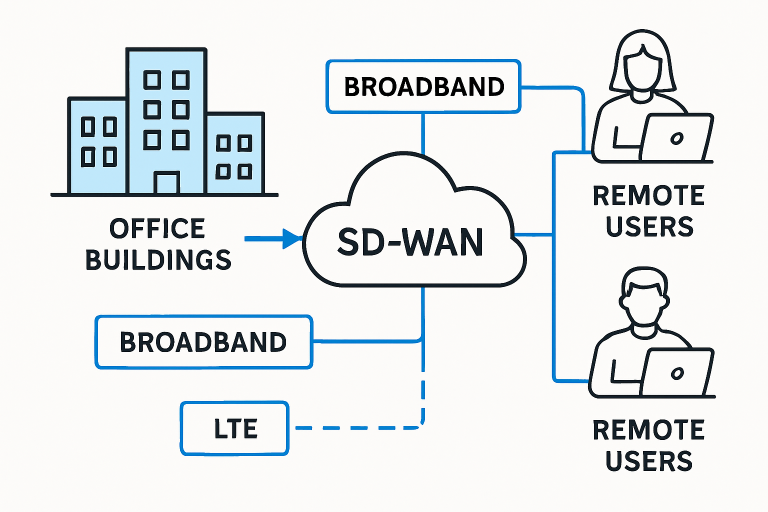

In the evolving digital era, organizations need their network infrastructure to be agile, secure, and scalable. As cloud applications, remote workforces, and rising data demands reshape business priorities, Software-Defined Wide Area Networking (SD-WAN) stands out as a transformative solution. More companies are turning to managed SD-WAN providers to achieve advanced connectivity that meets dynamic operational requirements without the complexity of legacy systems.
SD-WAN’s virtualized design provides flexibility in WAN management, enabling businesses to create robust, reliable connections across multiple transport methods, such as broadband, LTE, and MPLS. This capability not only optimizes network performance but also positions organizations to keep pace with the demands of digital transformation.
Understanding SD-WAN
SD-WAN is a software-driven approach to wide area networking that enables organizations to manage network connections and data flows from a central platform. Unlike traditional WAN setups, SD-WAN dynamically diverts traffic through the best available connection, whether broadband, fiber, or legacy MPLS, based on real-time needs. This ensures that critical applications always receive optimal bandwidth and minimal latency, even during peak usage.
With SD-WAN, network administrators gain fine-grained control over network resources using policy-based management. This framework enables faster deployment of new sites and services, simplifies remote-office connectivity, and equips organizations with the agility to support evolving business models. Additionally, monitoring and troubleshooting are greatly simplified, as administrators can visually track network performance and react to issues much faster than with legacy WAN configurations.
Key Benefits of SD-WAN
- Improved Performance: Critical applications are prioritized, guaranteeing minimal delay and consistent reliability for day-to-day operations and customer-facing transactions.
- Enhanced Security: SD-WAN platforms often embed security features such as end-to-end encryption, secure tunneling, and integrated firewalls, making it easier to maintain data security across distributed environments.
- Cost Efficiency: Shifting workloads away from expensive dedicated lines, such as MPLS, to more affordable broadband reduces network expenses while maintaining or improving service quality.
- Scalability: Organizations can easily scale bandwidth, add new branch offices, and support distributed teams without lengthy deployment timelines or rigid hardware upgrades.
Real-World Applications
Across industries, SD-WAN enables rapid adaptation. A multinational retailer, after merging with regional brands, used SD-WAN to unify office connectivity and provide seamless access to internal resources hosted in multiple cloud environments. This strategy enabled teams to collaborate in real time, improving productivity and maintaining business continuity during transitional phases.
Education, healthcare, and financial services organizations are also leveraging SD-WAN. Colleges manage heavy streaming requirements for e-learning, while banks depend on SD-WAN’s secure routing for real-time transaction data across dispersed branches. Each case underscores the technology’s versatility in modern business operations. For logistics companies, SD-WAN supports real-time tracking and improves communication between dispatch centers and remote vehicles, enhancing efficiency and visibility across supply chains.
SD-WAN and Cloud Integration
With more businesses moving resources to the cloud, direct and secure access becomes essential. SD-WAN simplifies the cloud migration journey by providing integrated cloud on-ramps that connect users directly to popular SaaS and IaaS providers such as Microsoft Azure, AWS, and Salesforce.
According to Cisco’s analysis of enterprise traffic trends, upwards of 90 percent of workloads now reside in cloud environments. SD-WAN is engineered to reduce bottlenecks and boost end-user experience by maintaining predictable, low-latency paths to cloud services. This results in faster access to essential platforms, reduced downtime, and reliable application performance, regardless of user location. Businesses embracing SD-WAN for cloud integration often experience significant improvements in their ability to deliver innovative services and support hybrid work styles, as network access is optimized across all endpoints.
Security Enhancements with SD-WAN
Security is a top concern as networks expand across public, private, and hybrid cloud environments. SD-WAN addresses these concerns by embedding advanced security layers into the network fabric. Centralized management enables uniform security policies, while integrated tools such as next-generation firewalls, intrusion prevention systems, and zero-trust verification ensure sensitive information remains protected as it traverses multiple networks.
Modern SD-WAN solutions frequently adopt a zero-trust approach, requiring strict user and device authentication for all resources, not just those inside a traditional security perimeter. This shift supports compliance with regulatory frameworks and strengthens the organization’s overall security posture against evolving cyber threats. Additionally, SD-WAN can help organizations address new types of threats with automatic updates and continuous monitoring, reducing the time to respond and recover from incidents.
Cost Efficiency and Performance
Legacy WAN infrastructure typically enforced the use of costly, proprietary circuits such as MPLS. SD-WAN transforms this model, allowing organizations to combine multiple transport options and route lower-priority traffic over affordable broadband or cellular links while reserving premium lines for mission-critical traffic. Companies using SD-WAN have reported up to 50 percent reductions in networking costs, alongside marked improvements in application responsiveness and uptime.
Automated traffic management enables key business applications, such as VoIP and video conferencing, to take priority, minimizing disruptions and enhancing productivity for distributed teams. These capabilities are especially beneficial for organizations with a global footprint, enabling streamlined operations and reduced connectivity costs across multiple regions.
Future Trends in SD-WAN
SD-WAN technology is rapidly evolving as demands for secure, intelligent, and integrated networks increase. The development of Secure Access Service Edge (SASE) frameworks combines SD-WAN with cloud-native security services, delivering seamless network connectivity with unified threat protection. Artificial intelligence and machine learning are beginning to influence SD-WAN management, offering predictive analytics and automated optimization to further improve performance and reliability.
As digital businesses move toward greater automation and real-time analytics, SD-WAN is poised to become the backbone of next-generation networking, supporting everything from IoT deployments to global hybrid workforces. With continuous innovation and the growing adoption of edge computing, SD-WAN will be the foundation for business networks that require both speed and adaptability in an increasingly complex technology landscape.
Conclusion
SD-WAN is a pivotal technology in the digital transformation journey, empowering organizations with adaptable, secure, and efficient networking solutions. As enterprises continue to modernize, adopting SD-WAN will be crucial to maintaining a competitive, resilient network infrastructure that can scale quickly to address changing operational needs. By leveraging the versatility and intelligence of SD-WAN, organizations can unlock new business models, boost customer experience, and drive long-term innovation.


