



Buying glasses online used to feel like a high-stakes gamble. You’d find a pair of designer frames for a fraction of the retail price, only to receive them two weeks later and realize you look like a confused extra from a 1970s sci-fi film, but the era of “guessing and hoping” is over.
The secret to a perfect pair of glasses (aside from a current prescription) is a tiny number called Pupillary Distance (PD). If you get this right, your online shopping experience changes from a cheap gamble to an efficient purchase decision. In this article, we’ll explain to how to measure your PD for buying glasses and sunglasses online.
What Exactly is Pupillary Distance?
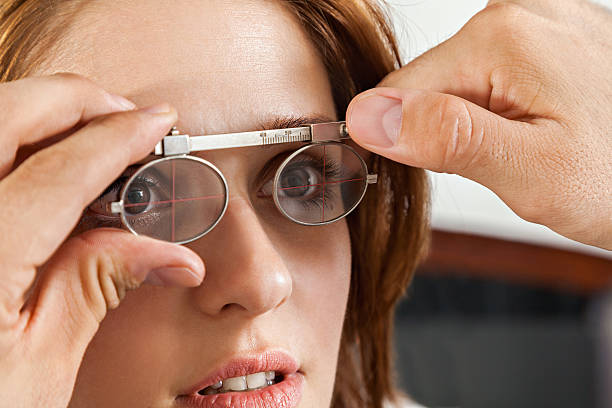
Pupillary distance is the measurement, in millimeters, between the centers of your pupils. It sounds simple, but it is the “X marks the spot” for your lenses. Optical lenses have an optical center—the point where the vision is clearest and distortion is lowest.
When your PD is accurate, the optical center of the lens sits directly in front of your pupil. If the PD is off, your eyes have to work overtime to look through a different part of the lens, leading to eye strain, headaches, and that “swimming” sensation that makes you want to lie down in a dark room.
There are two types of PD:
Binocular PD: The total distance between both pupils (for example 63mm).
Monocular PD: The distance from the bridge of your nose to each individual pupil (e.g., 31.5mm / 31.5mm). This is often more accurate, as many faces are slightly asymmetrical.
Method 1: The Manual “Ruler and Mirror” Technique
If you prefer a hands-on approach, you can measure your PD with a simple millimeter ruler and a mirror. It requires a bit of steady-handedness and a lack of self-consciousness about staring intensely at yourself.
Step-by-Step Instructions:
Find a Mirror: Stand about 8 inches (20cm) away from a well-lit mirror.
The Ruler: Hold a millimeter ruler flat against your forehead, just above your eyes.
Align the Zero: Close your right eye and align the 0mm mark exactly over the center of your left pupil.
The Measurement: Keep the ruler still and open your right eye while closing your left. Look straight ahead and note the millimeter mark that aligns with the center of your right pupil.
Repeat: Do this three times to ensure consistency. If you get 62mm, 63mm, and 62.5mm, go with the average.
Pro Tip: If you have a friend nearby, let them do it. Have them sit at the same height as you and use the ruler while you stare at a fixed point about 10–20 feet behind them. This prevents your eyes from “converging” (turning inward), which can happen if you look too closely at the person measuring you.
Method 2: Apps and Websites
For those who want to skip the ruler and leverage the tech in their pocket, apps and websites have become remarkably accurate. One of the most straightforward ways to measure your PD is pupillarydistancemeasure.com. They usually work by using your webcam or a photo to calculate the distance based on a reference object (like the magnetic strip of a standard credit card) held against your forehead.
Popular apps like EyeMeasure (for iOS) utilize the TrueDepth camera (the same tech used for FaceID) to create a 3D scan of your face, providing measurements accurate to within 0.5mm. This is often more precise than a DIY ruler attempt because it eliminates “parallax error”—the distortion that happens when the ruler isn’t perfectly flush with your pupils.
Buying Glasses Online: Beyond the PD
Once you have your PD and your prescription, the fun part begins. However, don’t just look at the style; look at the frame dimensions.
Most glasses have three numbers printed on the inside of the temple arm (e.g., 52-18-140).
Lens Width (52): The horizontal diameter of one lens.
Bridge Width (18): The distance between the two lenses (critical for how the glasses sit on your nose).
Temple Length (140): The length of the arms.
Use Virtual Try-On
Most modern retailers offer a “Virtual Try-On.” Use this to see how the frames interact with your jawline and eyebrows. Pay close attention to where your eyes sit in the “boxes” of the frames. If your eyes are too far toward the inner or outer edges, the frames might be too wide or narrow for your face, regardless of how cool they look.
The Verdict
Measuring your PD is the final hurdle to unlocking the convenience of online eyewear. Whether you use a manual ruler or pupillarydistancemeasure.com, you can measure your PD from home. With that one number in hand, you can confidently browse thousands of styles, compare prices, and finally get the high-end look without the high-end retail markup. Just remember: measure thrice, buy once.


