


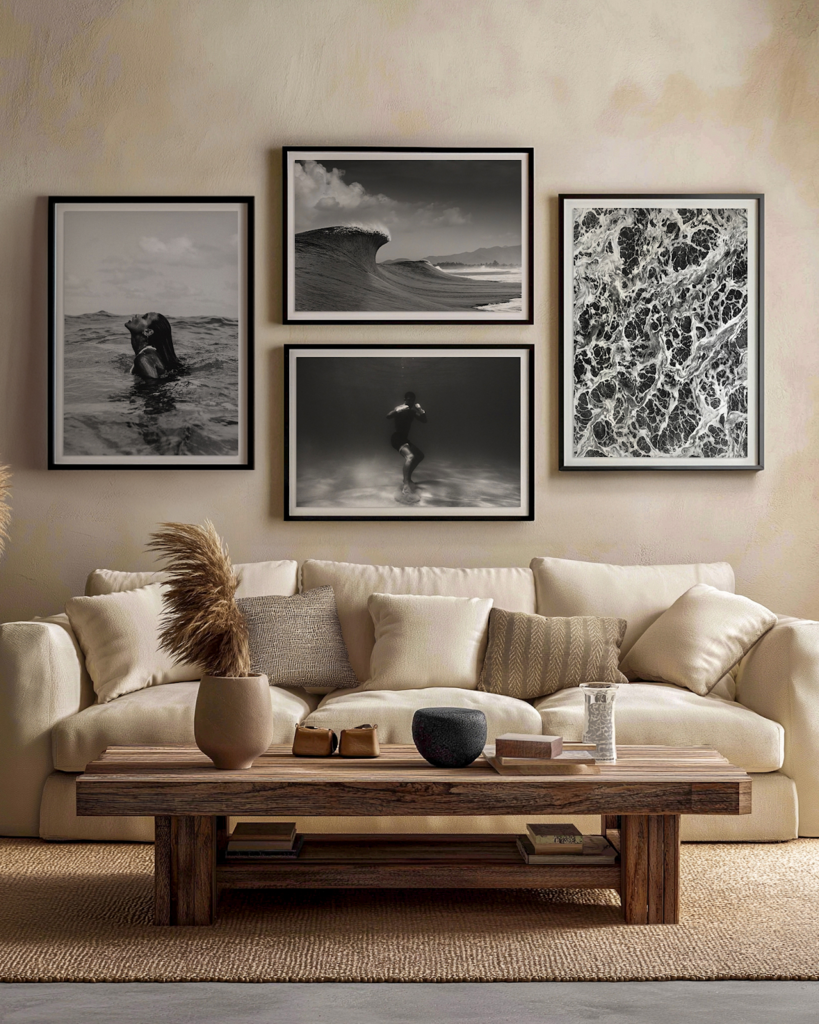

Few photographers have captured the essence of postwar leisure quite like Slim Aarons. His images—poolside gatherings in Palm Springs, ski chalets in St. Moritz, sun-drenched villas along the Mediterranean—offer more than nostalgia. They document a particular vision of American aspiration during the mid-20th century, one that continues to resonate in contemporary interiors.
Aarons spent decades photographing what he called “attractive people doing attractive things in attractive places.” That deceptively simple mandate produced a body of work that has become increasingly collectible. Today, his framed prints appear in design magazines, luxury hotels, and private homes, valued not just for their aesthetic qualities but for their cultural significance.
From War Photographer to Chronicler of Privilege
George Allen Aarons—who adopted the nickname “Slim” during his military service—began his career documenting combat during World War II. After the war, he made a deliberate pivot away from conflict photography. He sought out assignments that would take him to resort towns and exclusive enclaves, places where wealth and leisure intersected.
This shift coincided with broader changes in American visual culture. As photography gained recognition as fine art in the postwar period, practitioners like Aarons helped redefine what the medium could accomplish. His work appeared regularly in publications like Holiday and Town & Country, reaching audiences who saw in his images both aspiration and documentation.
What distinguished Aarons from his contemporaries was his approach to composition. He rarely directed his subjects, preferring to capture unguarded moments that felt spontaneous despite their careful framing. The result was a visual archive that felt both intimate and aspirational—a quality that has only grown more valuable as the era he documented recedes further into history.
The Mid-Century Photography Market
The market for vintage photography has evolved considerably since Aarons’s death in 2006. Collectors who once focused exclusively on traditional fine art have increasingly turned to photographic prints, particularly those from the mid-20th century. This shift reflects broader changes in how we value visual documentation.
Several factors have contributed to this trend:
- Institutional validation: Major museums now maintain significant photography collections, lending credibility to the medium
- Limited availability: Vintage prints from Aarons’s lifetime are finite, creating scarcity that drives collector interest
- Cultural nostalgia: The postwar period Aarons documented has become a touchstone for contemporary design aesthetics
- Accessible entry points: While rare vintage prints command premium prices, high-quality reproductions make Aarons’s work available to a broader audience
The market has matured significantly over the past two decades. Collectors now approach photographic prints with the same rigor they apply to paintings or sculpture, examining provenance, edition size, and print quality.
For those interested in acquiring Aarons’s work, options range from estate-authorized prints to vintage examples that occasionally appear at auction.
Integrating Photography into Contemporary Spaces
The challenge with any collectible artwork is finding the right context for display. Aarons’s photographs, with their saturated colors and horizontal compositions, present particular considerations for interior placement.
Design professionals often recommend treating these prints as anchor pieces rather than accent elements. Their scale and visual weight work best when given prominence—above a sofa in a living room, along a hallway gallery wall, or as a focal point in a dining area. The key is allowing the image enough breathing room to be appreciated without competing with surrounding elements. Collectors looking to acquire prints for these settings will find options through Leisure Piece, Sonic Editions, and King & McGaw, each carrying archival-quality reproductions suited to the prominent display positions designers recommend.
Color coordination deserves careful thought. Many of Aarons’s most iconic images feature the vivid blues of swimming pools and Mediterranean skies, warm terracotta tones, and the sun-bleached whites of mid-century architecture. These palettes can either harmonize with existing decor or provide deliberate contrast, depending on the desired effect.
Interior designers have noted that Aarons’s work translates surprisingly well across different aesthetic approaches. The same print that enhances a minimalist modern space can anchor a more traditional room, provided the framing and placement are thoughtfully considered. This versatility partly explains the sustained demand for his images.
Cultural Context and Lasting Influence
Understanding why Aarons’s work endures requires looking beyond its surface appeal. His photographs document a specific moment in American cultural history—the postwar decades when a newly prosperous middle class began to emulate the leisure activities of the wealthy.
The world Aarons photographed was overwhelmingly white and privileged, a limitation that contemporary viewers should acknowledge. His images capture a narrow slice of mid-century life, one that excluded vast segments of the population. This context doesn’t diminish the photographs’ aesthetic or documentary value, but it does complicate our relationship with them.
What makes his work relevant today is partly its distance from our current moment. The analog quality of the images, the fashions and social customs they depict, the very idea of unmediated leisure—all of these elements feel increasingly remote in our digital, hyperconnected age. Aarons’s photographs offer a window into a world that operated at a different pace, governed by different assumptions about privacy, status, and display.
Contemporary photographers and visual artists continue to reference Aarons’s aesthetic. His influence appears in fashion photography, lifestyle magazines, and even social media, where the carefully curated leisure shot has become a dominant genre. The difference, of course, is that Aarons was documenting an actual social world rather than constructing one for the camera.
Collecting as Investment and Appreciation
The question of whether photography constitutes a sound financial investment generates ongoing debate among collectors and advisors. Unlike stocks or bonds, art provides aesthetic dividends that complicate purely financial calculations.
For Aarons’s work specifically, several factors suggest sustained value:
- Established market: Decades of consistent collector interest have created price stability
- Institutional recognition: Museum acquisitions and exhibitions validate the work’s cultural significance
- Limited supply: Vintage prints are finite; even authorized reproductions are typically produced in controlled editions
- Cross-generational appeal: The work attracts both older collectors who remember the era and younger buyers drawn to its aesthetic
That said, collecting should be driven primarily by personal connection rather than speculative intent. The photographs that work best in a collection are those that genuinely resonate with the collector, that reward repeated viewing, that enhance the spaces they inhabit.
The Enduring Vision
Slim Aarons spent his career documenting a world of privilege and leisure that has largely vanished. The social customs, the unself-conscious displays of wealth, the assumption of privacy even in public spaces—all of these belong to a different era. Yet his photographs continue to captivate viewers precisely because they preserve something that feels increasingly distant.
In an age of constant digital documentation, there’s something refreshing about Aarons’s analog approach. His subjects weren’t performing for social media or constructing personal brands. They were simply living—or at least, that’s the illusion his photographs so skillfully create.
Whether displayed in a contemporary home, a corporate office, or a hotel lobby, these images carry a particular kind of cultural weight. They remind us of a time when leisure was less democratized, when travel meant genuine distance from daily life, when a photograph was a rare and considered thing rather than an endless stream of disposable images.
For collectors and design enthusiasts, Aarons’s framed prints offer more than decoration. They provide a tangible connection to a specific moment in visual culture, one that continues to influence how we think about aspiration, leisure, and the good life. That combination of aesthetic appeal and cultural significance explains why, decades after they were first captured, these images remain as compelling as ever.


